
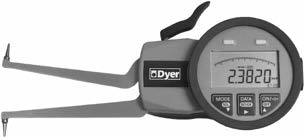
Groove gages aren’t one-size-fits-all: the right gage depends on the part in front of you. Answer these six questions and the choice usually makes itself.
1. What’s the access diameter?
The gage arms must pass through the smallest opening on the way to the groove. Small, deep bores point to the 210-211 Series; standard bores to the 103 Series.
2. Is the groove in a recess or undercut?
Grooves behind a shoulder or in a counterbore need retracting arms shaped for the recess — that’s the 651 Series for recessed bores or the recessed-bore 103 Series.
3. How deep is the reach?
Long housings and cylinders need long arms without flex: 101 Series longer-reach gages or 102 Series long-arm gages.
4. Diameter only — or width, depth, and spacing too?
If the print calls out groove width, depth, or groove-to-groove spacing, look at the 255, 256, and 902 Series — they’re built for those callouts specifically.
5. Dial or digital?
Dial gages are rugged and battery-free. If quality wants logged data, the electronic 651 and 650 three-point Series output to data collectors for SPC.
6. How many parts per shift?
A handful — any indicating gage works. Hundreds — weight, arm retraction, and operator comfort start to matter. That’s where purpose-built beats improvised, every time.
Fastest path: skip the guessing, send the print. contact Dyer Gage or call the gage hotline at 1-800-631-3333 — Dyer builds custom arms and contacts in 1–5 days, so “the catalog doesn’t have it” is rarely the end of the conversation.