
Every shop eventually meets a print with a dimension no catalog gage can touch: a groove behind a web, a wall over a flange nobody planned for, a bore feature at the bottom of a blind pocket. You have three options — section parts, build a fixture in-house, or get a custom gage. Here’s when each makes sense.
Most “custom” jobs are really custom arms
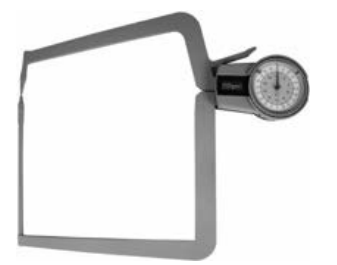
The gage body — frame, dial, mechanism — rarely needs reinventing. What needs to change is the reach: arm length, arm shape, contact geometry. That’s why Dyer treats custom arms and contacts as a standard 1–5 day service, not an engineering project. The 103 Series special arm designs and 101 Series special arms show the range: angled arms, offset arms, extended reaches, application-specific contacts.
When the whole gage is purpose-built
Some measurements need more than arms — checking coaxiality of two bores (454 Series), gear and spline sizes on the floor (gear & spline gaging), or aerosol crimp diameters (303 Series). These started life as someone’s impossible print. See special applications and custom designs for the pattern.
What a gage builder needs from you
- The print — or at least the feature callout with tolerance.
- Access constraints — what’s in the way, from which direction the gage approaches.
- Volume — 10 parts a month vs. 1,000 a shift changes the right answer.
- Data needs — dial read is fine, or does quality want SPC output?
Custom doesn’t mean slow or exotic
The reputation custom gaging has for long leads comes from full ground-up builds. Arm-and-contact customs ship in days, and even purpose-built specials are usually weeks, not months. If a dimension is costing you sectioned parts or arguments with QC every week, the custom gage pays for itself fast.
Stuck on a dimension right now? contact Dyer Gage or call the gage hotline at 1-800-631-3333 — send the print and the answer is usually “yes, and here’s the arm sketch.”