
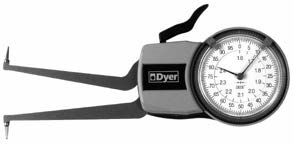
Measuring an O-ring or seal groove buried inside a bore is one of the most common headaches in a machine shop. The groove is bigger than the bore you have to reach through, so calipers and standard bore gages can’t touch it. Here are the three methods shops actually use — and what each one is good for.
Method 1: Balls and grease (the old-school check)
Hold two or three precision balls in the groove with a dab of grease, measure over the balls, and do the math. It works in a pinch, but it’s slow, operator-dependent, and easy to get wrong on deep or narrow grooves. It’s a spot-check, not a process.
Method 2: An indicating O-ring/groove gage (the production answer)
A direct reading groove gage has arms that retract to slip through the bore, then expand into the groove. You rock the gage, read the dial, and you’re done — a few seconds per part, repeatable from operator to operator. Dyer’s 103 Series direct reading O-ring/groove gages hold linear accuracy of ±0.0005″ and are built for exactly this job. For grooves in recessed bores and undercuts, the 103 Series recessed-bore version reaches where standard arms can’t.
Method 3: Electronic groove gages (when you need data)
If your quality system wants SPC data or you’re checking hundreds of parts, an electronic groove gage like the 651 Series gives you a digital readout and output for data collection — same fast in-the-groove measurement, with numbers you can log.
Which method should you use?
- One-off part, no gage on hand: balls and grease will get you close.
- Production runs, in-process checks: a direct reading groove gage — fast, repeatable, shop-rugged.
- SPC / data collection requirements: an electronic groove gage.
Common questions
How accurate are indicating groove gages? Dyer direct reading groove gages hold ±0.0005″ linear accuracy at 0.100″ of travel, with repeatability better than most shop-floor requirements.
What if my groove is nonstandard? Dyer builds custom arms and contacts in 1–5 days for odd groove widths, depths, and reach requirements.
Not sure which gage fits your part? Send a print — contact Dyer Gage or call the gage hotline at 1-800-631-3333 and a gaging engineer will spec it for you.